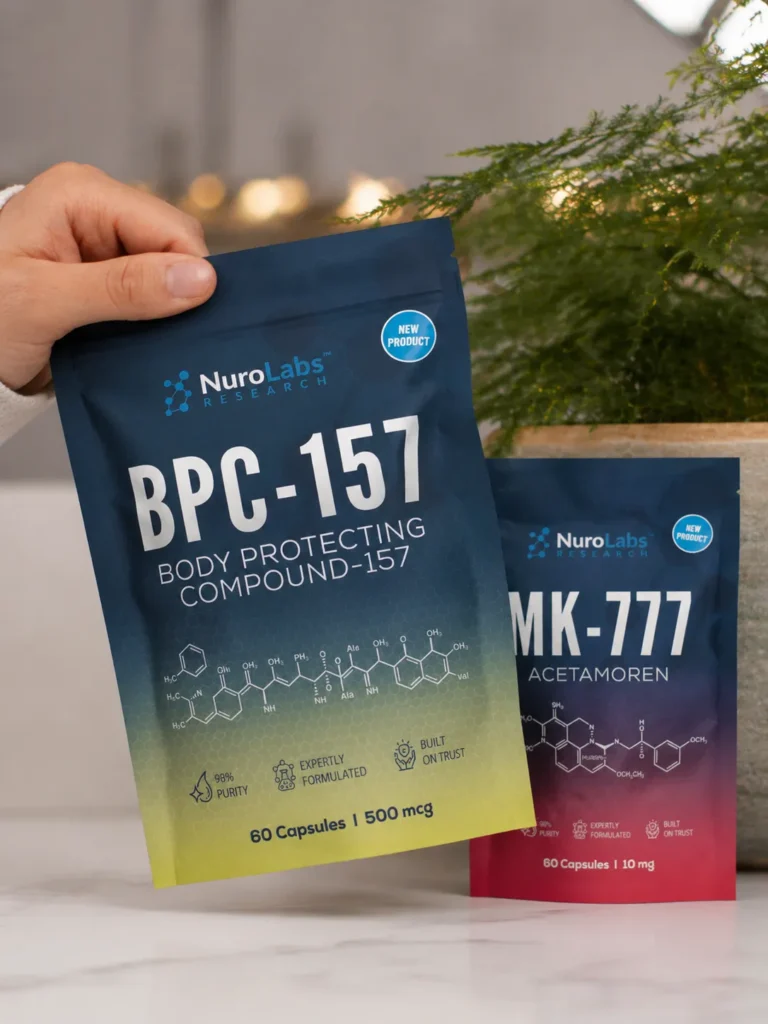
Peptides are widely used across research environments, but their quality and reliability depend heavily on how they are handled. Incorrect reconstitution or poor technique is one of the main reasons for cloudiness, slow dissolution, contamination, or inconsistent results.
At NuroLabs Research, peptides are supplied strictly as lyophilised solids, allowing full control over how they are mixed and stored.
1.1 Bring to Room Temperature
Before starting, allow both the peptide vial and solvent to reach room temperature. Mixing cold solvent with a cold vial can increase the chance of cloudiness, slower dissolution, and poor mixing.
1.2 Prepare a Clean Area
Work on a clean surface and use proper lab hygiene.
This reduces the risk of contamination entering the vial.
1.3 Equalise Pressure If Needed
Some vials may have slight vacuum or internal pressure.
Insert a sterile needle briefly into the stopper and allow pressure to equalise. This helps prevent solution being forced out when solvent is added.
1.4 Add Solvent
Adding solvent slowly is not mandatory, but it helps prevent foaming, which can slow the dissolution process.
Foaming is not necessarily harmful, but it can introduce bubbles, slow dissolution, and make the solution less uniform at first.
The goal is simple. Do not create excessive bubbles or foam.
1.5 Do Not Shake
Do not shake the vial, as this can introduce foaming and air, leading to slower and less consistent dissolution.
Instead, lightly swirl and leave.
1.6 Let It Sit and Dissolve
Once solvent is added, leave the vial for 5 to 15 minutes. Most peptides will dissolve naturally.
If needed, gently swirl. Do not force the process.
2.1 Sterile Water
A clean solvent with no preservatives. Suitable for most peptides. Simple formulation.
Best suited for short term use where the solution will be used quickly.
After reconstitution, due to the absence of preservatives, solutions should ideally be used within a short timeframe, typically within 24 to 72 hours under controlled conditions, and stored at 2 to 8°C.
While some peptides may remain stable longer depending on structure, extended storage over multiple weeks is not recommended when using sterile water.
2.2 Bacteriostatic Water
Sterile water containing a preservative, commonly around 0.9 percent benzyl alcohol.
Allows repeated vial access and reduces microbial growth.
After reconstitution, when stored at 2 to 8°C, solutions are typically used within a longer timeframe, commonly up to around 28 days under controlled conditions.
Actual stability will vary depending on peptide structure, handling, and storage conditions.
2.3 Saline
Usually 0.9 percent sodium chloride.
Used in certain environments but not suitable for every peptide. Some peptides may not dissolve well or remain stable.
2.4 Blended Solvent Systems
Some solvent systems combine bacteriostatic water with 0.9 percent sodium chloride, providing both preservative and saline components.
These may be used in certain conditions, but compatibility depends on the peptide.
2.5 Dilute Acetic Acid
Used for more difficult or hydrophobic peptides to improve solubility.
2.6 DMSO
A stronger solvent used for hydrophobic or difficult to dissolve peptides. Should be used carefully.
3.1 Store lyophilised peptides at minus 20°C for long term storage or 2 to 8°C for short term storage.
3.2 Keep dry, sealed, and protected from light.
4.1 Store at 2 to 8°C, keep tightly sealed, protect from light, and avoid contamination.
4.2 Avoid Freeze Thaw Cycles
Repeated freezing and thawing reduces stability over time. If needed, split into smaller portions.
5.1 Do not use if you see cloudiness, particles, precipitation, colour change, or signs of contamination.
6.1 This content is provided for informational and research guidance purposes only. All products supplied by NuroLabs Research are intended strictly for laboratory research use and must be handled by qualified personnel under appropriate conditions.
6.2 Nothing within this guide should be interpreted as medical, clinical, or therapeutic advice.
6.3 For full details governing the purchase, handling, and use of our products, please refer to our Terms and Conditions.
6.4 NuroLabs Research accepts no liability for misuse or improper handling of research materials.
6.5 For research use only.
Discount Applied Successfully!
Your savings have been added to the cart.